
How to Mine Bitcoin
Trying to mine Bitcoin at home is like buying a lottery ticket – the chances of winning are minimal, but you never know…
The laws around printing money are very strict. If you print counterfeit money at home, the Thought Police will get you, and you’ll go to jail. Printing legal tender is something only governments are allowed to do.
But, surprisingly, you can effectively ‘print’ Bitcoin at home, spend it, and stay on the right side of the law.
The bad news is that big corporates have got into Bitcoin mining on an industrial scale, which makes home Bitcoin mining a bit like buying a lottery ticket.
If you’ve read our page on How does Bitcoin Work?, you’ll know that to make money from mining you need to guess the right number for a particular block before someone else does.
The chances of your tiny home computing set-up beating the giant computational power of a professional mining company is very slim – but not impossible!
Here’s how to give yourself a chance…
Mining Bitcoin at Home
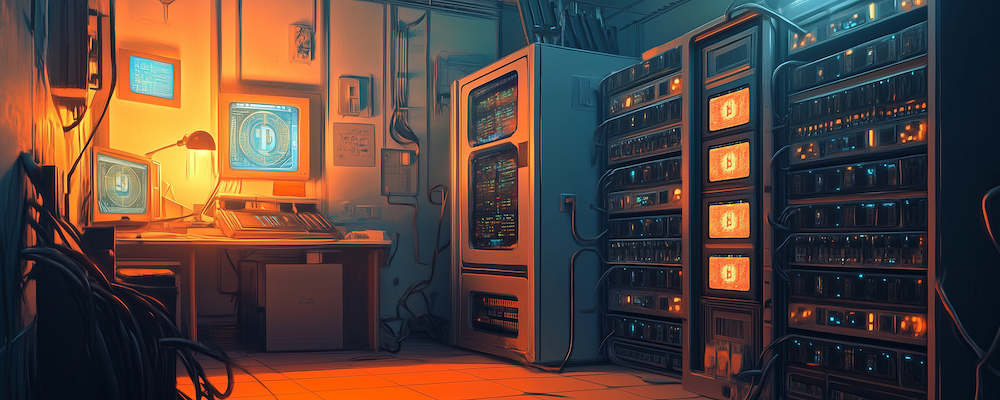
‘Mining’ is yet another misnomer in the Bitcoin world. You don’t get out your spade and dig up your garden to mine Bitcoin.
Here are the main ways you can mine Bitcoin at home:
- Back in the day, people used to download mining software onto their home computer. This is known as CPU/GPU mining, as you use your computer’s existing Central Processing Unit (CPU) or GPU (Graphics Processing Unit) to carry out the computations. Home computer CPUs and GPUs aren’t great at the type of calculations needed for Bitcoin, so you’re very, very unlikely to hit the jackpot with this method. Best to avoid it.
- The standard way of mining Bitcoin at home nowadays is to buy a dedicated ‘ASIC’ mining rig. ASIC stands for Application-Specific Integrated Circuits. ASIC miners are purpose-built to carry out the Bitcoin algorithm (SHA-256). You can get little ASIC miners that plug into a USB socket or standalone devices.
Be aware that some ASIC mining rigs make a lot of noise, blow out hot air, and are expensive to run.
If you’re married and stick one in your living room, you may end up with a divorce. Unless of course you happen to mine an actual block, in which case your spouse will stick around to enjoy the winnings.
Miner manufacturers to consider for home mining include:
Solo Mining

Once you have bought a Bitcoin mining machine, the next step is to work out how you mine.
The first option is to mine on your own – this is known as ‘solo mining’. You let your mining rig run, and, if by some miracle you manage to mine the next block, the whole Bitcoin reward plus transaction fees are paid direct to your wallet. Yippee!
For a solo miner to mine a Bitcoin block, the stars have to be perfectly aligned. It’s very unlikely you will be successful.
To set up solo mining, you can go to Solo CK Pool and follow the instructions. If that’s too complicated – which it probably is – check out Ben Perrin’s video below on home mining which also covers how to solo mine with Solo CK Pool.
Bitcoin Mining Pools

An alternative to mining on your own is to join a ‘mining pool’.
You lend your computing power to a larger mining group and, if one of the miners in the group manages to mine a block, you get a share of the Bitcoin block reward. Your share is generally in proportion to the computing power you have made available to the pool.
Some mining pools are for professionals only, others allow home miners as well. Here is a list of some mining pools you can join as a home miner, but bear in mind companies do sometimes change their protocols and may shut home miners out over time:
| Bitcoin Mining Pool | Location |
|---|---|
| Braiins Pool | Czech Republic |
| Ocean | USA |
| KanoPool | USA |
| ViaBTC | China |
| AntPool | China |
| CloverPool | China |
| F2Pool | China |
| Poolin | China |
Summary
- The only sensible way to carry out home mining is to buy an ASIC mining rig.
- The chances of you mining a Bitcoin block as a solo miner at home are similar to winning the lottery, i.e. very low indeed.
- You can start to get some very modest income by joining a mining pool, but you need to weigh your Bitcoin mining income against the cost of the electricity required to run the ASIC computer.
Useful Resources
> In this video, Ben explains how to set up and use a relatively inexpensive home Bitcoin mining ASIC for both solo and pool mining:
> Bitcoin mining machines can give off a lot of heat and here we learn about a company that manufactures a device that doubles as both a heater and a Bitcoin miner:
Where to Next?
If you’ve been reading the sections in order, the next page we recommend is Live Bitcoin Price.